


Snake Clash!
Supercent, Inc.
I went into Snake Clash expecting a familiar snake game, but its appeal becomes clearer after a few rounds. The basic idea is immediate: move through a battle arena, collect what helps you grow, and try to outlast other snakes. It is a free arcade game from Supercent, Inc., rated for Everyone, and it is easy to understand before you have learned any complicated rules. That simplicity is the reason I kept starting another match.
The game does not ask me to build a long-term strategy before the action begins. I can pick it up, make a few movements, see the result, and decide almost instantly whether I want to try again. That makes it a good fit for short breaks, especially when I want something more active than a passive time-killer but less demanding than a full competitive game.
How the first move sets the whole match in motion
The opening seconds are the most important part of each round because they teach the controls through consequences rather than instructions. I move, watch the snake respond, and immediately start judging space: where can I grow safely, which direction gives me room to turn, and where might another snake cut me off? The controls feel most useful when I stop treating movement as simple steering and start thinking about the shape of the arena.
That first action creates a small but satisfying chain. I make a move, collect something or position myself better, become more capable of taking risks, and then look for a stronger target. The game’s store summary describes the goal as eating others and becoming the strongest in the battle zone, but in practice the interesting part is deciding when strength is enough to attack and when survival is the smarter choice.
I found that rushing toward every opportunity usually makes a round shorter. A safer approach is to keep an escape route open. If I move too close to the edge of the action, a sudden turn can leave me with very little room. Staying slightly away from crowded areas gives me more choices, even if growth feels slower. This is one of the first useful lessons the game teaches: the biggest visible reward is not always the best immediate move.
Related News

Why WhatsApp Messenger Still Makes Everyday Communication Feel Easy

Jurassic World: The Game Is the Better Dino Tycoon for Strategic Players

Threads in Real Life: Who Should Join, Lurk, or Leave

How SHEIN Turned Shopping Into an Endless Content Feed

How to Make Fortnite Feel Smarter on Mobile

Should You Switch to Microsoft Outlook on Mobile?
The arcade format works well here because the objective is readable without being completely automatic. I do not need to study a rulebook, yet I still have decisions to make. The first move is simple; the consequences are where the game gets its personality.
The feedback rhythm is clearer than the rules
What kept me playing was the speed of the feedback. A good movement produces an obvious benefit, while a careless one can quickly put the run in danger. That rhythm makes each short match feel like a compact experiment. I try a route, see whether it creates room or trouble, and adjust on the next attempt.
There is a useful difference between losing because I made an ambitious play and losing because the arena became difficult to read. The former feels like my decision, which makes a restart appealing. The latter can feel more frustrating, particularly when several snakes occupy the same area and the safest route is not immediately obvious. I would have preferred a little more breathing room during those crowded moments, but the pressure is also what stops the matches from becoming completely predictable.
Gallery
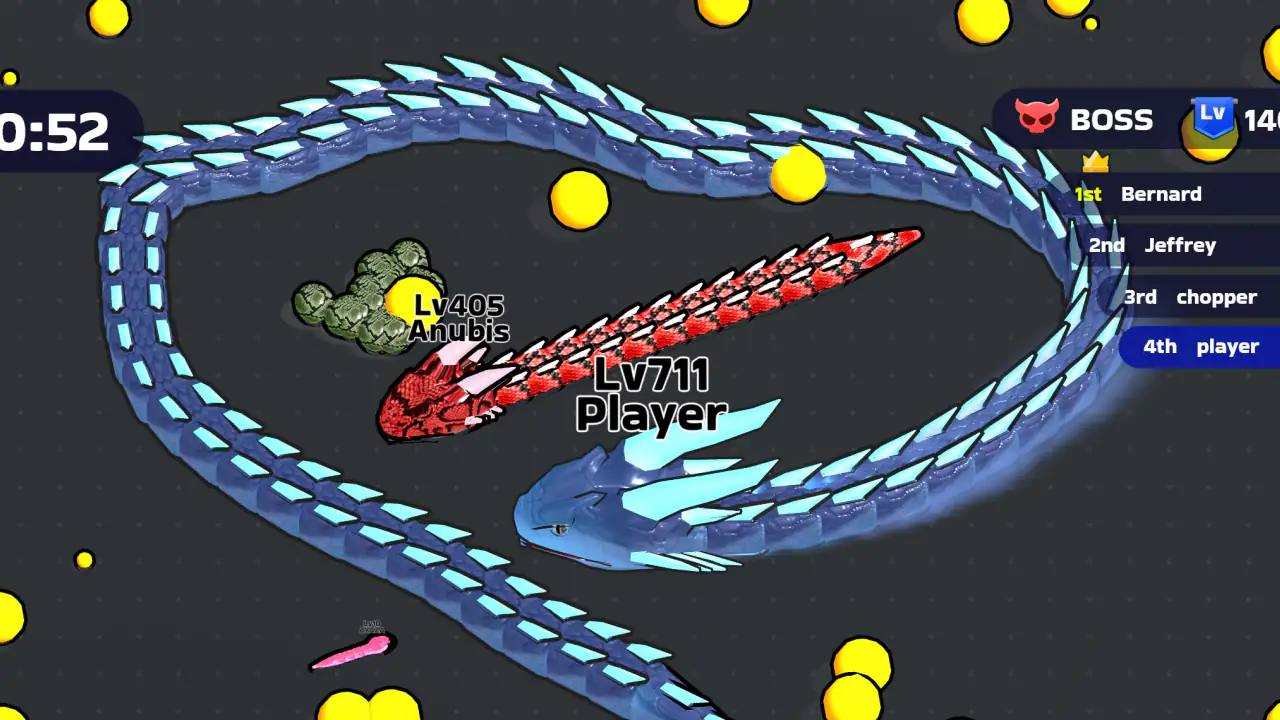
For new players, I recommend watching the path ahead rather than focusing only on the snake’s current position. The best turns are prepared early. If I wait until danger is right beside me, I am often reacting too late. Small adjustments are more reliable than dramatic last-second changes, especially when the arena is busy.
Another practical habit is to treat the edges as temporary tools rather than permanent shelter. Moving near an outer boundary can help me avoid a cluster, but it can also reduce my turning options. I use the edge to reset my position, then return toward open space before the next decision. That simple workflow makes the game feel less chaotic and gives each match a clearer shape.
The feedback also explains why the game is approachable for younger players. The content rating is Everyone, and the central action is easy to recognize. Still, accessibility should not be confused with depth. A player can understand the objective in seconds, but improving at positioning takes more time because every crowded encounter tests timing and awareness.
Why growth feels rewarding, even in a short round
The reward structure is strongest when progress changes how I see the arena. At the start, I am mainly trying to avoid mistakes. After gaining enough size or advantage, I begin evaluating other snakes as possible opportunities instead of treating every nearby movement as a threat. That change in viewpoint is what makes growth feel meaningful.
I also like that the reward arrives in stages. A small success may simply give me more confidence to approach a busy area. A larger success can make the next decision feel more ambitious. The game does not need a long story or elaborate presentation to create momentum; the match itself supplies the reason to continue.
My most effective tactic was to separate collecting from attacking. When the arena offered a safe route for growth, I focused on that rather than chasing another snake immediately. Once I had more room to maneuver, I looked for situations where an opponent’s movement limited its own options. This is less exciting than charging straight into danger, but it produced more consistent rounds.
That approach also reveals a trade-off. Playing carefully can make the early portion of a match feel slower, while aggressive play creates faster highs and faster resets. Players who enjoy constant action may prefer the riskier style. I personally found the best balance by using caution at the beginning and becoming more assertive once I had enough space to recover from a mistake.
Because the game is free, it is easy to test this style without committing money first. In-app purchases range from $0.99 to $99.99 per item, so I would advise treating optional spending as a separate decision from whether the core loop is enjoyable. I did not need to spend to understand why the game works, and anyone who dislikes the basic movement and restart cycle is unlikely to solve that problem through purchases.
The large audience gives some useful context without changing my personal experience. The game has an average rating of 4.5 from around 1.1 million ratings and has passed 100 million installs. Those figures suggest that the short-match concept has broad appeal, but they should not be mistaken for a guarantee that every player will like the pace. Someone looking for a slower puzzle experience may find the repeated pressure tiring.
The reset is part of the design, not just a punishment
Every match eventually ends, and the reset is what gives the game its repeatable structure. A loss is disappointing when I feel I was close to a better result, but it also removes the pressure of protecting a long, complicated campaign. I can start again immediately with one concrete lesson in mind: leave more space, avoid a risky chase, or turn earlier.
This is where the game fits everyday use particularly well. If I have a few minutes while waiting for an appointment or taking a break between tasks, I can play a round without needing to remember a story, manage a team, or return to a large map. The session has a clean beginning and end. Even when I lose quickly, the restart does not feel like a major interruption.
There is a downside to that convenience. The reset loop can become repetitive if I am not enjoying the act of steering itself. The game’s appeal depends on whether small improvements feel satisfying to me. Players who need persistent unlocks, a detailed campaign, or a strong narrative reason to return may find the structure too thin.
I also think the reset rewards a particular kind of self-review. After a failed round, I try to identify the first bad decision rather than blaming the final collision. Usually the match was already in trouble several moves earlier, when I entered a crowded area without a clear exit. That makes the next attempt more purposeful. I am not merely repeating the same route; I am testing a different choice.
The current version is 69.8.0, and the game supports devices running Android 6.0 or later. That makes it accessible to many Android users with older compatible phones, although the experience will still depend on how smoothly a particular device handles the action. I would check the operating-system requirement before downloading if I use an older handset.
Where it beats familiar arcade alternatives
Compared with a traditional solo snake game, this one feels more confrontational because other snakes turn the arena into a changing tactical problem. I am not only planning around walls or my own trail; I am watching for opportunities and threats created by other participants. That gives each round more surprise than a purely predictable obstacle course.
Compared with a large multiplayer action game, it is much easier to enter. There is no need to learn a long list of abilities before the first meaningful decision. The trade-off is that the experience is narrower. I get a focused snake battle loop rather than character progression, team coordination, or a broad competitive system.
It also differs from idle arcade games, where much of the progress happens automatically. Here, my attention matters during the match. A reward only helps if I can use the improved position well. That makes the game more engaging for me than an app that mostly asks me to watch numbers rise, but it also means it is less suitable when I want something completely hands-off.
The strongest comparison is therefore not about graphics or scale; it is about commitment. Snake Clash asks for quick attention, not a long session. If I want a game that gives me a clear action, immediate feedback, a visible reward, and a fast reset, it has a strong case. If I want a deep progression system, it is not the better choice.
Who should play it, and who should skip it
I would recommend it to someone who enjoys quick arcade rounds and likes improving through repetition. It is especially suitable for players who enjoy movement-based decisions but do not want complicated controls. The Everyone rating also makes it an approachable choice for a broad household audience, provided each player is comfortable with the competitive pressure of the arena.
It is a good match for short breaks because a round can be treated as a self-contained challenge. I can set a small personal goal, such as staying away from crowded zones or waiting longer before attacking, and finish the session with a clear sense of what I learned. That is more satisfying than playing without a purpose.
I would skip it if I dislike repeating similar matches after a loss. I would also look elsewhere if my priority is a story, a carefully ordered campaign, or a calm puzzle experience. The game’s strength is its immediate loop, so its limitations are tied to the same design: there is not much distance between starting, acting, failing, and trying again.
Players who are sensitive to optional purchase prompts should pay attention to how they feel during normal play and avoid buying simply because a round went badly. The most useful improvement is usually better positioning, not an impulsive purchase. Keeping that distinction clear helps the free entry point remain genuinely useful.
My verdict on the action-reward-reset loop
After spending time with it, I see the game as a polished example of a focused arcade idea. The first action is instantly understandable, the feedback arrives quickly, growth changes the way I approach the arena, and the reset gives every mistake a reason to become another attempt. The real hook is not merely becoming bigger; it is learning when that advantage is worth risking.
Supercent, Inc. has kept the concept direct enough for casual players while leaving room for better judgment. My favorite moments came from controlled decisions: collecting safely, reading an opponent’s route, and turning a small advantage into a stronger position without becoming reckless. Those moments are brief, but they are clear enough to make a restart feel worthwhile.
At the same time, I would not call it a universal recommendation. The repeated arena format can wear thin, and players seeking substantial progression will probably want a different arcade or action game. Its free price makes trying it easy, while the optional purchases mean I would approach spending carefully rather than assuming it is necessary.
Overall, I recommend Snake Clash for anyone who wants a quick, readable battle game that rewards attention more than preparation. It works best when I treat each round as a small lesson: make a move, read the result, take the reward, accept the reset, and return with one better decision. That compact cycle is exactly why another session begins.
FAQs for Snake Clash!
What is Snake Clash! and how does it differ from traditional snake games?
Snake Clash! is an innovative twist on the classic snake game, offering multiplayer elements and competitive gameplay. Unlike traditional versions, where you simply grow a snake by eating objects, Snake Clash! allows you to compete against other players in real-time. This adds a strategic layer, making it more engaging and challenging.
What are the key features of Snake Clash!?
Snake Clash! boasts several exciting features including real-time multiplayer battles, customizable snakes, and a variety of arenas. Players can also participate in seasonal events and challenges, offering rewards and a chance to climb leaderboards. These elements combine to create a dynamic and competitive experience.
Is Snake Clash! free to play, and are there in-app purchases?
Yes, Snake Clash! is free to download and play. However, it does offer in-app purchases for cosmetic items, power-ups, and other enhancements. While these purchases can enhance the gameplay experience, they are entirely optional and the game remains enjoyable without them.
What are the system requirements for Snake Clash! on Android and iOS?
For Android users, Snake Clash! requires version 5.0 or higher, while iOS users need version 10.0 or later. The game is optimized for both phones and tablets, ensuring smooth performance and graphics. It's always a good idea to check for compatibility before downloading to avoid any issues.
How does Snake Clash! handle user data and privacy?
Snake Clash! adheres to strict privacy policies to ensure user data is protected. The app collects minimal personal information, primarily for enhancing the gaming experience and maintaining leaderboards. Users can review the privacy policy within the app for detailed information on data usage and management.
Pros
- Intuitive controls for easy gameplay.
- Variety of levels keeps it engaging.
- Colorful graphics enhance the experience.
- Smooth performance with no lags.
- Multiplayer mode adds excitement.
Cons
- Ads can be a bit intrusive.
- Limited customization options.
- Requires internet for multiplayer.
- In-app purchases can be pricey.
- Lacks offline single-player mode.


